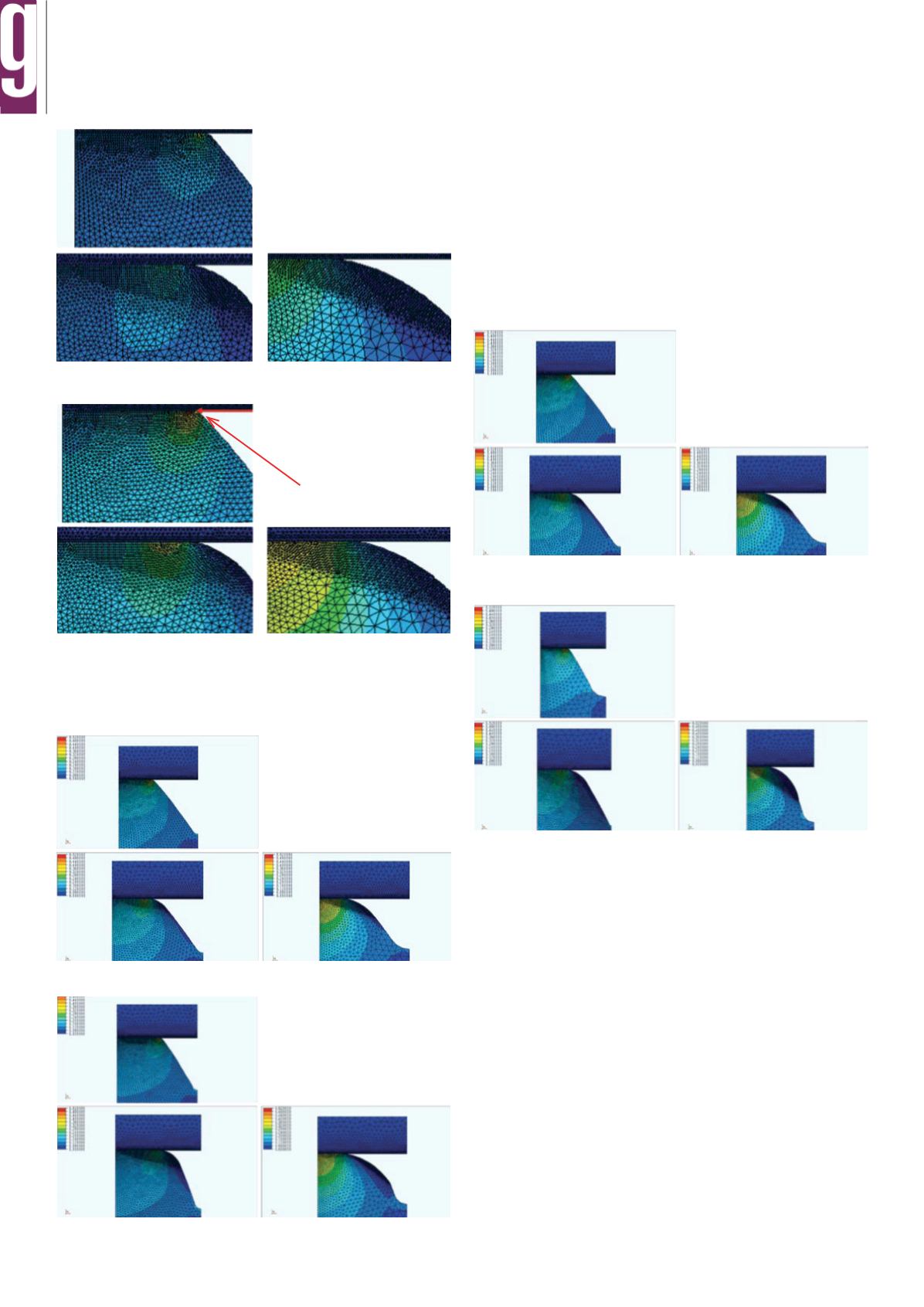
2. Flat tops still win out as dot size increases
This next example considers a 30 percent and 50 percent dot under the same
loading conditions.
The results, as expected, show that as the dot gets bigger the stresses
experienced decrease. What is interesting is the fact that the decrease
with the analogue and the Flexcel NX Plate dots is much more significant
than that for the traditional digital LAMS dot. These models verify:
• Dot size affects stress concentrations.
• Stress levels decrease less for rounded dots.
3. The effect of resolution on plate wear
The final case considers what happens as resolution increases, and whether
there is a trade-off between resolution and potential plate life. In the following
two examples, the line screen increases from 150lpi to 200lpi.
The results show that the stresses increase, but do not change a great deal.
However, they are more concentrated than before, and indicate that increasing
resolution can potentially negatively affect plate life. These models verify that:
• Smaller dots further concentrate the stress and potential wear rates.
Conclusions
The graphical nature of the stress profile plots means that the figures included in
this white paper are relatively easy to read, and demonstrate clear findings that
the stresses and the significant concentration of stresses around the tip of the
rounded dot of traditional digital LAMS plates, will cause a significantly
increased likelihood of accelerated wear.
The flat top dot structure of analogue or conventional dots, along with those of
Flexcel NX Plates, distributes the stresses more effectively and evenly, reducing
the stress concentration and the likelihood of plate wear.
Additional feedback gathered from printers has clearly confirmed that flat top
dot structures have a positive impact on plate life. Printers are reporting plate
life of 2-5 times longer with flat top dot structures, with the differences often
higher when more abrasive substrates are used. This provides additional
evidence that flat top dot structures are superior for on-press impression
and plate life performance.
Flexcel NX System
Flexcel NX System
Flexcel NX System
Flexcel NX System
Conventional Analogue
Conventional Analogue
Conventional Analogue
Conventional Analogue
Digital LAMS
Digital LAMS
Digital LAMS
Digital LAMS
Stress profiles are VERY
dot shape-dependent
Increasing LPI (smaller
minimum dot) increases
stress concentration
Highest peak stress,
fast dissipation
Increasing LPI (smaller
minimum dot) increases
stress concentration
30% Halftone, 150 lpi,
3 thou (75 mm)
engagement
30% Halftone, 150 lpi,
5 thou (125 mm)
engagement
30% Halftone, 150 lpi,
3 thou (75 mm)
engagement
50% Halftone, 200 lpi,
5 thou (125 mm)
engagement
Flexcel NX System
Conventional Analogue
Digital LAMS
Increasing dot %
decreases stresses
30% Halftone, 150 lpi,
5 thou (125 mm)
engagement
Flexcel NX System
Conventional Analogue
Digital LAMS
Change is less significant
for Digital LAMS
50% Halftone, 150 lpi,
5 thou (125 mm)
engagement
Vol 4 Issue 3 • THE RISE AND RISE OF FLEXO
62
I
The GAPP
magazine
www.
thegapp
.co.za


