Reading the results
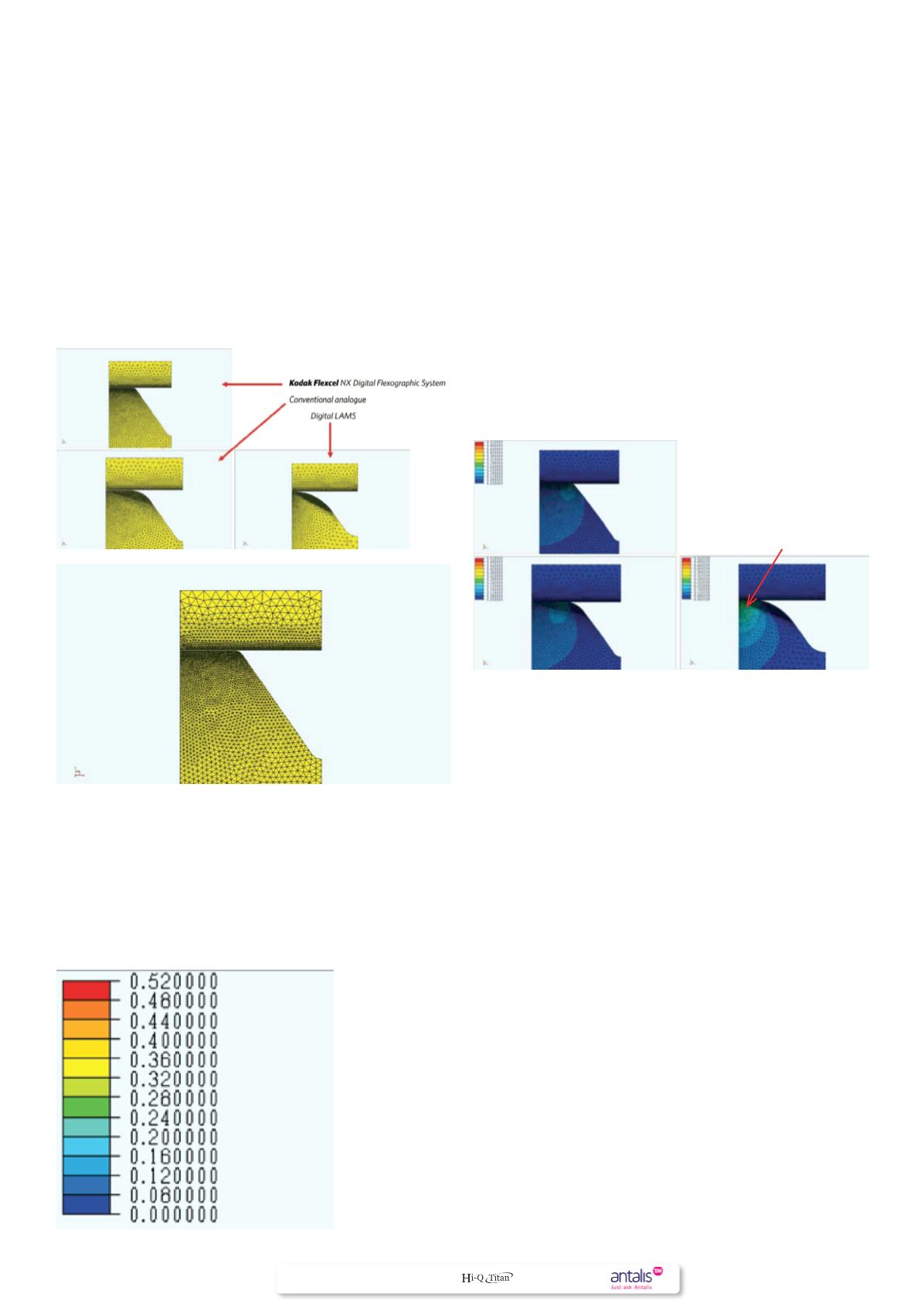
Reading the results is very simple. The blue colours indicate low stresses and
probable low wear rates: the brighter the colour higher up the scale, the higher
the stress and the faster the probable wear.
For the base case WCPC was instructed to use standard photopolymer
properties based on data from their flexo material research that started in 1998,
and to use dot profiles based on its scientific non-contact measurements. The im-
ages below show the standard profiles considered. The lower part of each image
represents the dot, and the upper part represents the impression surface. All sets
of images in this report are arranged in the same configuration, with the Flexcel
NX Plate samples to the upper left and the traditional digital LAMS
samples to the lower right.
Fixing the Scale
To help make the reading of the results as transparent as possible, WCPC was
instructed to use the same scale for the stresses on all of the results. This means
that the blue, yellow, or red colours represent the same stress levels on ALL of
the figures allowing instant reading and simple comparison.
As the colour moves from blue to green to yellow, then to orange and red, the
stresses get higher.
Loading Conditions
The model then considers the deflection of the tip of the dot at two pre-set
distances, to mimic the dots under two levels of impression setting. The
distances used were 3 thousandths of an inch or 75 microns, and 5
thousandths of an inch or 125 microns.
Interpretation
The author, Dr John Anderson, a nine-year, three-degree graduate of SU, has
been carrying out and reviewing FEA results since 1992, with extensive
application throughout his time in Swansea. What follows is Dr Anderson‘s
analysis of the results, based on the data supplied by WCPC. The basic premise
is that plate areas that undergo the highest stress levels lead to the greatest
amount of plate wear. The largest areas of higher stresses indicate the fastest
probable wear conditions.
The Results
1. Flat tops reduce stress and wear
The first case applies the two standard loading conditions to a 30% dot at 150lpi.
The results show that the peak stress on the Flexcel NX Plate is a small point
where it transitions rapidly from no load to fully loaded. This is a very small area
and should not cause significant wear stresses.
Comparing the profiles of the dots, it is clear that the Traditional Digital LAMS
dots show very significant stresses over a large area, especially at the tip or
contact point. This would be expected to cause much faster rates of wear than
either the Flexcel NX Plate or conventional analogue dot structures.
It is clear from the image that the flat top dot structures distribute the loading
more evenly, reducing the stresses, and the potential for wear. Increasing the
engagement to the higher setting shows that the overall stresses experienced
increase in all three cases, but again the two flat top dot structures on the left
have much smaller increases, and are devoid of large and significant stress
concentration throughout the whole contact region.
The models have therefore verified a few key points, even with just these two
loading cases:
• Dot shape has a significant effect on the stress profile.
• Stress level increases as the engagement (impression) increases.
• The flat top dot structures distribute or share the loading better to achieve
lower stresses.
• The rounded shape of the traditional digital LAMS dot, results in the highest
stress concentrations, suggesting the highest wear rates.
• The stresses are focused in the contact zone.
Several of these findings are intuitive, and the results of the tests appear to be
logical. The following figures show these two conditions in more detail.
The results explain some common dot growth issues that occur at the start of
production with traditional LAMS dots, and the common practice of cutting the
minimum dots off at higher dot sizes or dot percentage to increase plate life.
Kodac Flexcel NX Digital Flexographic System
Flexcel NX System
Conventional Analogue
Digital LAMS
High stress concentration
increased wear rates
30% Halftone, 150 lpi,
3 thou (75 mm)
engagement
Printed on 128 gsm Hi-Q Titan Gloss supplied by
I
61


