E
ach different type of ink and drying or curing requirement will influence
the production environment and the types of work which can be
produced. One factor which is directly influenced by the printing
technology used, is the range of substrates which can be used
and the types of jobs which can be printed.
As with all sectors of the printing industry, and business as a whole, signage
and large-format printers are looking for ways of saving money or reducing
costs while increasing productivity. EFI Vutek has a solution, the GS3250LX
LED-based printer. This versatile and innovative printer offers printers the
ability to not only reduce costs, but also to increase productivity. The printer
was presented to customers at an Antalis open day held at its head office
in Johannesburg. The aim was to show specific customers what the printer
can do for their businesses.
The GS3250LX uses LED light for curing. This has a number of advantages.
LED light has a lower operating temperature than UV Arc lamps or Latex Arc
lamps. LED lamps have an operating temperature range of 29 – 35 degrees,
while UV Arc lamps operate at 60 – 66 degrees C, and Latex Arc lamps at
98 – 104 degrees C. There are numerous benefits from this lower temperature.
The most obvious is that the lower temperature requires less energy. This
has direct cost-saving implications because lower energy requirements
mean lower costs for energy.
In addition to that, the lower operating temperature means that there is less
heat released into the production environment. Increased ambient heat has
direct and negative effects on the substrates being printed which can result
in higher waste levels. By reducing the temperature in the production
environment, substrate damage can be lessened, as can the level of
air-conditioning required. This also has another benefit in that damaged
substrates often cause head-strikes which can not only damage the print
job but can also result in costly damage to the printing heads.
The lower heat also provides the benefit of being able to print onto thinner
and non-standard substrates. Thinner substrates can be damaged by the heat
of UV or Latex Arc lamps. LED lamps will not cause the same damage and
therefore, thin substrates become a viable option. This can provide you
with the ability to give your client cost savings as thinner substrates are
less expensive, they cost less for shipping and there is less post-consumer
waste when the product is no longer needed.
Non-standard substrates also become viable due to the lower operating heat.
These would mainly include such substrates as plastics, rubber, vinyl and even
wood laminates which could be damaged or even destroyed by the heat from
the curing process. One product which is often used in packaging applications
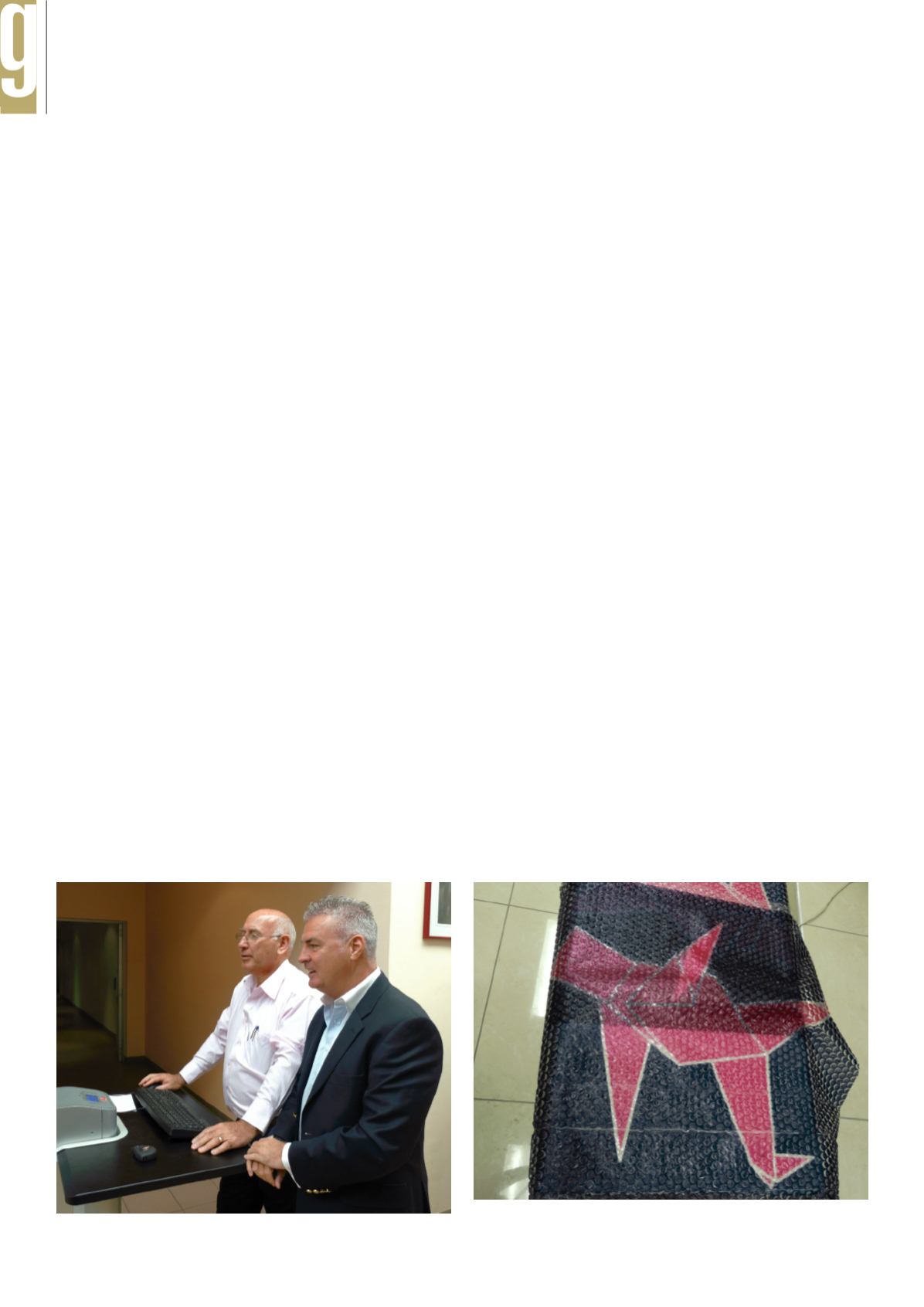
but which remains unbranded is bubble-wrap. Now with the GS3250LX even
this ubiquitous substance can have identifiable printing applied to it.
The lamps used for curing, in most large-format printers, are usually one of
the big costs and are treated as a consumable given their relatively short
lifespans. The LED lamps in the Vutek machine last considerably longer than
ARC lamps – up to 10 000 hours – and also do not contain any harmful
substances such as the Mercury used in the hotter lamps. The other factor
associated with the lifespan of the bulbs is that LED does not result in any
loss of quality or shift in colour due to bulb degradation. LED lamps also do
not require extended periods of time for the lamps to warm up. This means
that production can start sooner and the machine can be switched off when
not in use for extended periods without resulting in lengthy delays while
the lamps rewarm.
According to Herbert Uren, product manager of Visual Communications at
Antalis, the GS3250LX offers users the optimal combination of productivity,
versatility and cost-savings. He added, ‘While the EFI Vutek GS3250LX uses
a specific set of inks, the benefits of greater production latitude and lower
energy consumption far outweigh any extra cost in terms of inks. When you
factor in the reduction in waste, both of substrate and ink, this device offers
printers the highest levels of cost efficiency and cost effectiveness.’
In addition to all these cost-saving benefits, the GS3250LX also includes
a number of features which make it a highly productive machine. With a
maximum production speed, in Fast-5 mode comprising CMYK and White,
of up to 232sqm per hour, it is a fast and economical machine. In full
eight-colour plus white mode it can still output up to 111.4sqm per hour.
It offers two selectable resolutions of 600dpi or 1000dpi. A wide range
of white printing options give total flexibility. These include over-print,
under-print, spot, under-spot, fill and over-spot.
The printer can handle a wide range of flexible and rigid substrates. Rigid
substrates up to 3.2 metres in length and 50.8mm thick can be printed. This
means that substrates can be directly printed, thereby reducing the need for
post-printing mounting. This is a further productivity enhancing feature.
The focus in all industries is rapidly moving to environmentally-friendliness
and all that this concept entails. It is no longer sufficient to avoid pouring
harmful chemicals down the drain, you now have to consider everything
from the carbon footprint of your company right down to the impact of the
post-consumer waste which will be created at the end of the life-cycle of
the product you manufacture. The EFI Vutek GS3250LX allows large-format
and signage printers to do just that with the minimum of effort.
Stan Gorman of Antalis with James Mellor of EFI.
The Vutek GS3250LX can print on a range of difficult substrates even
bubble wrap.
52
I
The GAPP
magazine
www.
thegapp
.co.za
Vol 4 Issue 3 • ANTALIS HOSTS LARGE-FORMAT OPEN-DAYS


