H
owever, paper is not always paper and not all paper is the same.
Synthetic papers offer a plethora of effects and benefits and can very
often be used in the same way as paper and even offer the ability to do
things which paper cannot. While all paper merchants will certainly be
able to tell you about the papers which they supply, their main focus will be on
the high-volume market where they can turn around tons of paper in order to
achieve maximum benefit. There is a need in the market for a paper supplier
who can offer something different, not only in terms of paper and the advice on
how to use it for maximum benefit, but also supplying very small quantities.
Papersmith & Son is just such a merchant. According to managing director Rob
Haden-Smith, the changes which have taken place in recent years in the printing
industry have had drastic effects on the paper supply market. He added, ‘The
market for fine papers is not growing, the international market for stationery
paper and text and cover papers is actually declining at up to 13 percent per year.
Certain product types are still showing growth but there are other sectors of the
conventional print market which are not positive. The volumes of paper being
used in general are down and still dropping.
‘Papersmith & Son was founded to be a specialist merchant serving a small
sector of the market, specifically the high-value, low-volume portion of the
market. Packaging is generally considered to be a safe-haven, but even in
this sector we only address the top-end in terms of value with the products
we supply.’
This focus on speciality and niche markets has not only offered Papersmith some
protection against the decline which the rest of the market has experienced but
has also ideally positioned it to address new growth areas. If packaging is a new
growth market, then cosmetics is the pinnacle of that market and Papersmith
has a market-leading product for this sector. Trucard from Tullis Russell is a range
of coated and uncoated solid bleached sulphate boards available in a range of
finishes for a variety of applications. Imitlin is a range of embossed papers with
the ideal strength for binding, packaging and lining.
Packaging is not the only growth sector of the printing industry. Signage,
point-of-sale and viscom are also high on the list of emerging sectors of the
wider printing market. Priplak is a plastic material designed specifically for this
market. It can be handled and converted in a number of different ways and is
easy to use. It is ideally suited to the large-format digital print market because
it is up to 35 percent lighter than other plastic sheets, which means that it
offers interesting opportunities to the point-of-sale market.
Rob added, ‘The digital printing arena has become very interesting for us because
there are so many new products available on the market which printers can now
print onto using their digital presses. We have even worked closely with some
of the digital equipment suppliers to create a dedicated portfolio of papers and
substrates for the digital print sector. We have a range which is internationally
certified for use on the HP Indigo presses and we are now looking for products
which work on toner-based machines.’
There is a strong drive in the paper market to search for more environmentally-
friendly solutions. Recycled paper, synthetic paper and paper from sustainably
managed plantations are receiving a lot of attention at the moment. Papersmith
offers a number of products which meet these requirements. Polyart is a plastic
paper with all the traits and printing characteristics of normal coated paper.
Cyclus is a fully recycled paper which reduces its impact on the environment.
Forest Stewardship Council™ (FSC™) certification is a priority and forms a
minimum requirement at Papersmith.
Rob commented, ‘By offering our corporate clients a variety of alternatives,
we are able offer them the ideal product for their specific requirements. There
is a big drive among corporations towards reducing their carbon footprint,
especially those in the food market. They want to ensure that all the
packaging their products come in is not harmful to the environment.
‘As a paper merchant, our range is the most environmentally-friendly in the
local market. This is not something that we have merely claimed, it has
been independently measured. There is a calculator on the World Wildlife
Fund (WWF) website which allows merchants and printers to measure the
environmental friendliness of specific papers and we have used this to
calculate our product’s rating. It is really quite impressive.’
Papersmith & Son is not simply relying on the mainstream printing industry, but
is rather looking at new sectors where paper is used. Given that it does not rely
solely on the large volumes which form the staple of most paper merchants it
can look at smaller sectors. An example of this is the art sector where it can
supply textured and grained papers to the water-colour and etching art market.
Quantities are small but the value is high. Photographic reprints is another
niche market which Papersmith can address.
Papersmith & Son has positioned itself in such a way that it can address the
needs of large printers, as well as the small end-user market. Through its
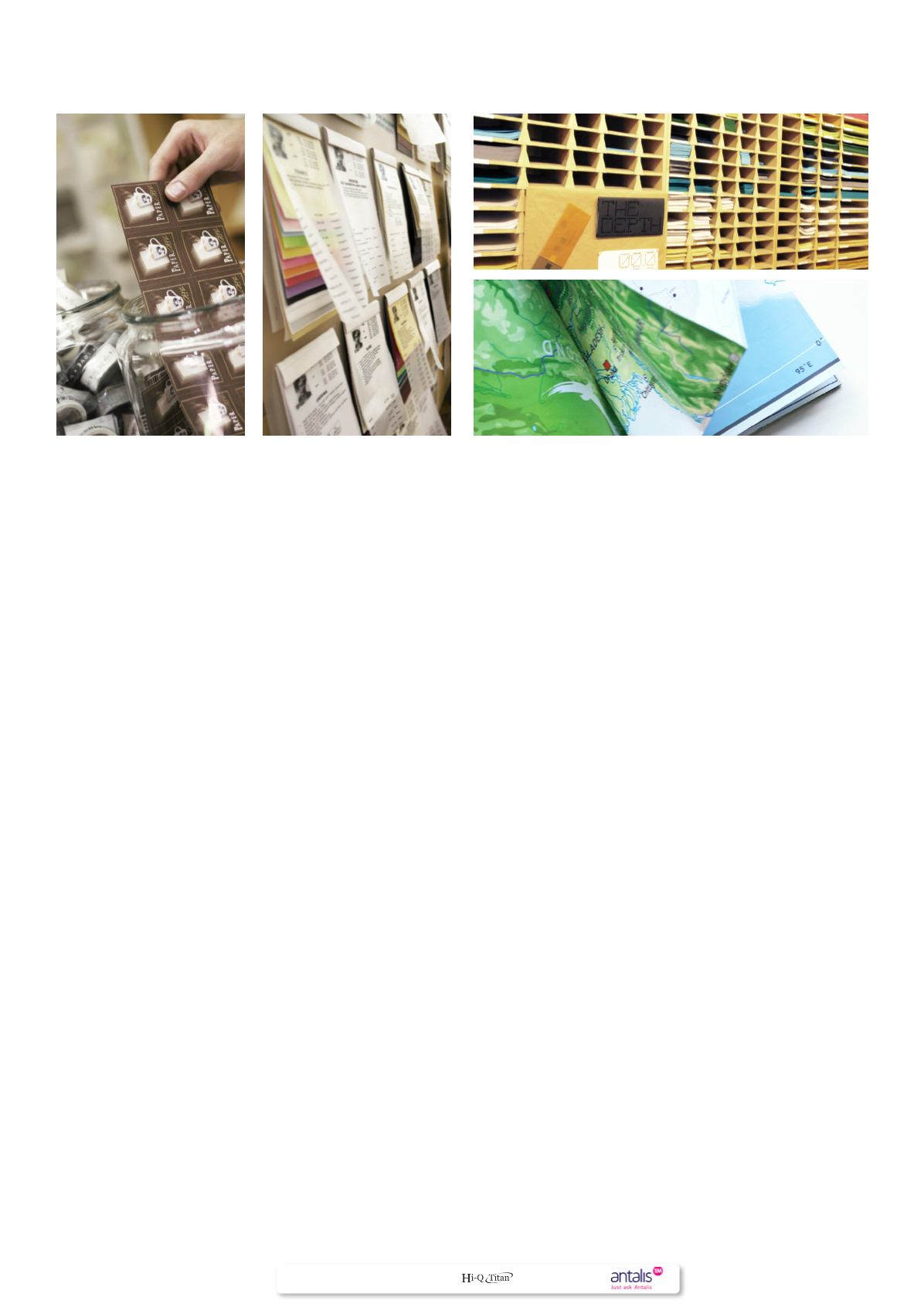
Papercafe it has direct access to the end-user and designers, to printers and
print buyers. This allows it to directly address the buyers of paper, the people
who will be responsible for specifying the paper that will carry the identity of
their companies forward.
Rob concluded, ‘As a company, and specifically as a paper merchant, we are
by no means large, but our size is what gives us the edge. We can move and
respond to changes in the paper market as they occur. We are not bound by the
volume constraints which affect other merchants. We can be more proactive
and this is our greatest strength because it allows us to meet our customers’
needs quickly.’
Printed on 128 gsm Hi-Q Titan Gloss supplied by
I
75


