P
rint Syndicate is not the sort of company to wait patiently as can be seen
from its rapid growth since its formation in 1997. Based in Jeppestown,
Print Syndicate was formed by Alf Dickerson and Dennis Fraser with just
two staff and a single-colour press. It now employs 35 staff members, has
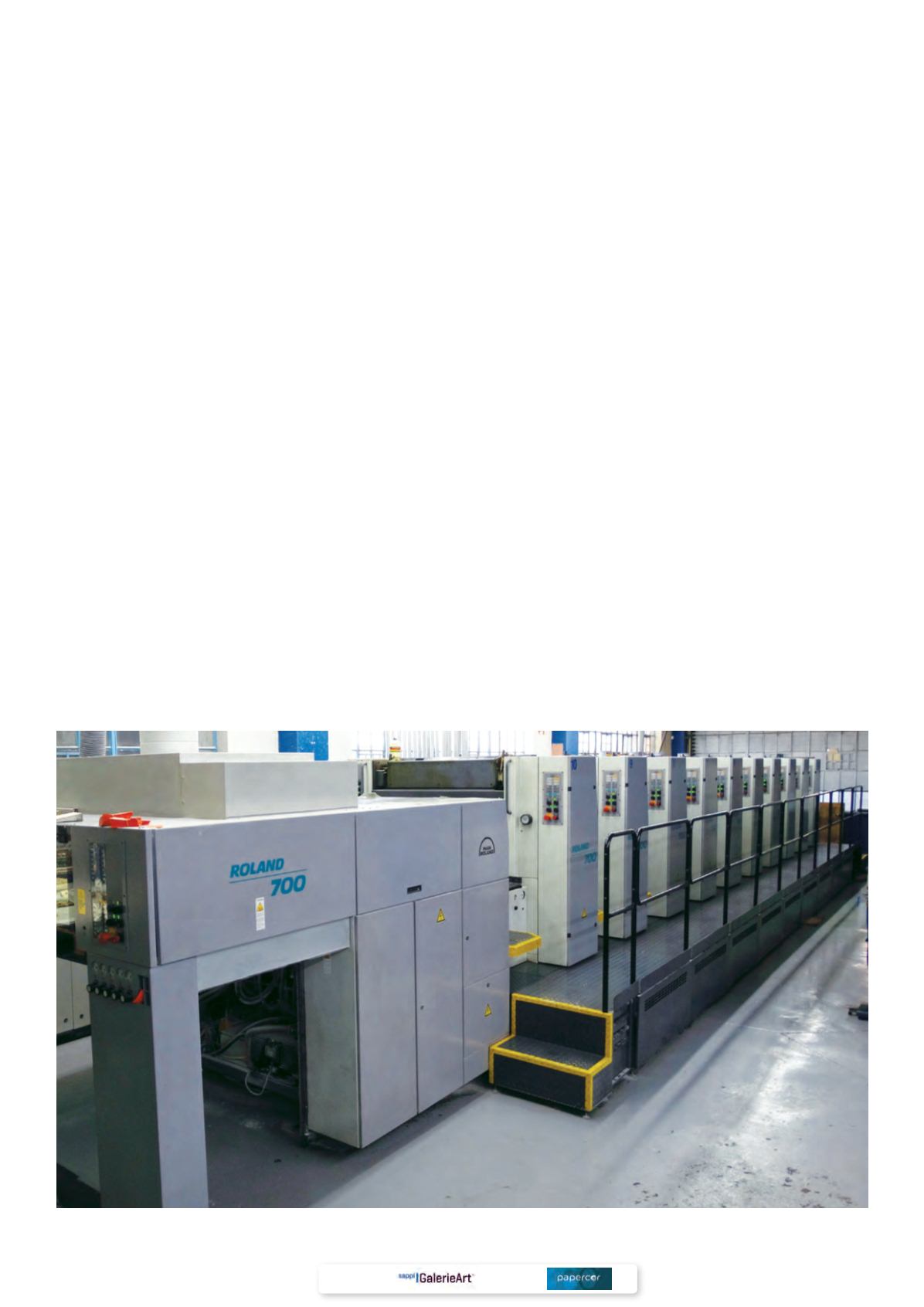
a ten-colour Roland 700, a five-colour Heidelberg Speedmaster, two two-colour
presses and a KORD. Not only that but all of its production requirements are
met in-house with the only outsourced work being UV varnishing of covers
where required.
Finishing including saddle stitching, perfect binding and box gluing is all done
in-house and allows Print Syndicate to control its own production schedules.
Said Dennis Fraser, ‘We are not a big company but we like to make sure that we
meet our clients’ demands quickly and with the highest quality possible. We have
brought as many processes in-house as we could so as to ensure that the quality
remains high and that turnaround times are kept to the minimum.
‘It was for this reason that we realised we needed to replace our existing
computer-to-plate system because it was just too slow. We were achieving a
throughput of just six A1 plates per hour and this meant that it was taking an
hour and a half to make the plates for our ten-colour press. The result was that
we were having to run for 24 hours in the platemaking department just to keep up
with the demands of all our A1 presses. It also meant that there many occasions
when some of the presses were standing waiting for plates to be made.’
At the end of 2013, Dennis started the process of looking for a faster
platesetter, one which could handle a larger volume of plates and at the
same time achieve savings in chemistry and energy consumption.
The most suitable and cost-effective solution came in the form of
the Cron UVP4648FI platesetter from Thunderbolt. With the ability to
produce up to 23 plates per hour, speed was the main factor in favour
of the device. However, there are a number of other features which
made it the perfect fit.
The Cron platesetter is able to image both conventional and UV CTcP plates
allowing Print Syndicate to reduce its costs by as much as 30 percent compared
to the thermal plates it was using. In addition, the chemistry for conventional
and UV plates is also cheaper. This reduction in costs allows Print Syndicate to
offer its clients preferential pricing.
There are additional savings which Print Syndicate has experienced. Guenther
Naubereit, sales manager from Thunderbolt commented, ‘Thermal plates require
much higher levels of energy. The Cron uses 405Nm laser diodes to image the
plates. These draw roughly a quarter of the energy of the thermal lasers. Another
benefit of the laser diodes is that if one diode fails, that bank can be removed
and the device can continue imaging until it is replaced. The laser diodes are also
considerably cheaper than the thermal imaging heads.’
The Cron platesetter at Print Syndicate has been configured as a fully automatic
system with a single plate cassette which holds 200 plates. However, should the
output requirements of the company change in time, the Cron is fully modular and
additional functionality, including additional cassettes or imaging heads, can be
added if required.
The Cron has also offered Print Syndicate other benefits. Dennis commented, ‘The
chemistry we use with the Cron and the UV plates has no harmful substances in it
which means that we can dispose of it down the drain without any concerns that
we may be causing damage to the environment. This means that without having
to make any special disposal arrangements or incurring extra costs, we can still
be environmentally friendly.
‘We have also noticed that the UV plates give us a better quality print. We are
able to achieve a sharper dot and improved reproduction – almost matching
photographic quality in some cases. Not only that but we are actually able to
reduce the amount of ink because we can achieve better ink densities with the
UV plates.’
While all of these benefits are additional validation for the decision to install the
Cron platesetter, it is the speed of platemaking which offers the greatest benefit.
Dennis concluded, ‘We can now make all the plates for an entire day of printing
during a single shift in the platemaking department. Just two people are able to
keep up with the workload to keep all five of our presses running.’
The ten-colour Roland 700 at Print Syndicate is now able to operate at maximum capacity since the new platesetter was installed.
Printed on supplied by
I
65


