T
here are various types of 3D printing, some require a base or substrate
to build upon, others do not. As with traditional 2D printing there are
many processes, many applications and many final products which can
be achieved with 3D Printing. The latest one to arrive in the South African
market is available from a company aptly named 3D Printing Systems. The printer
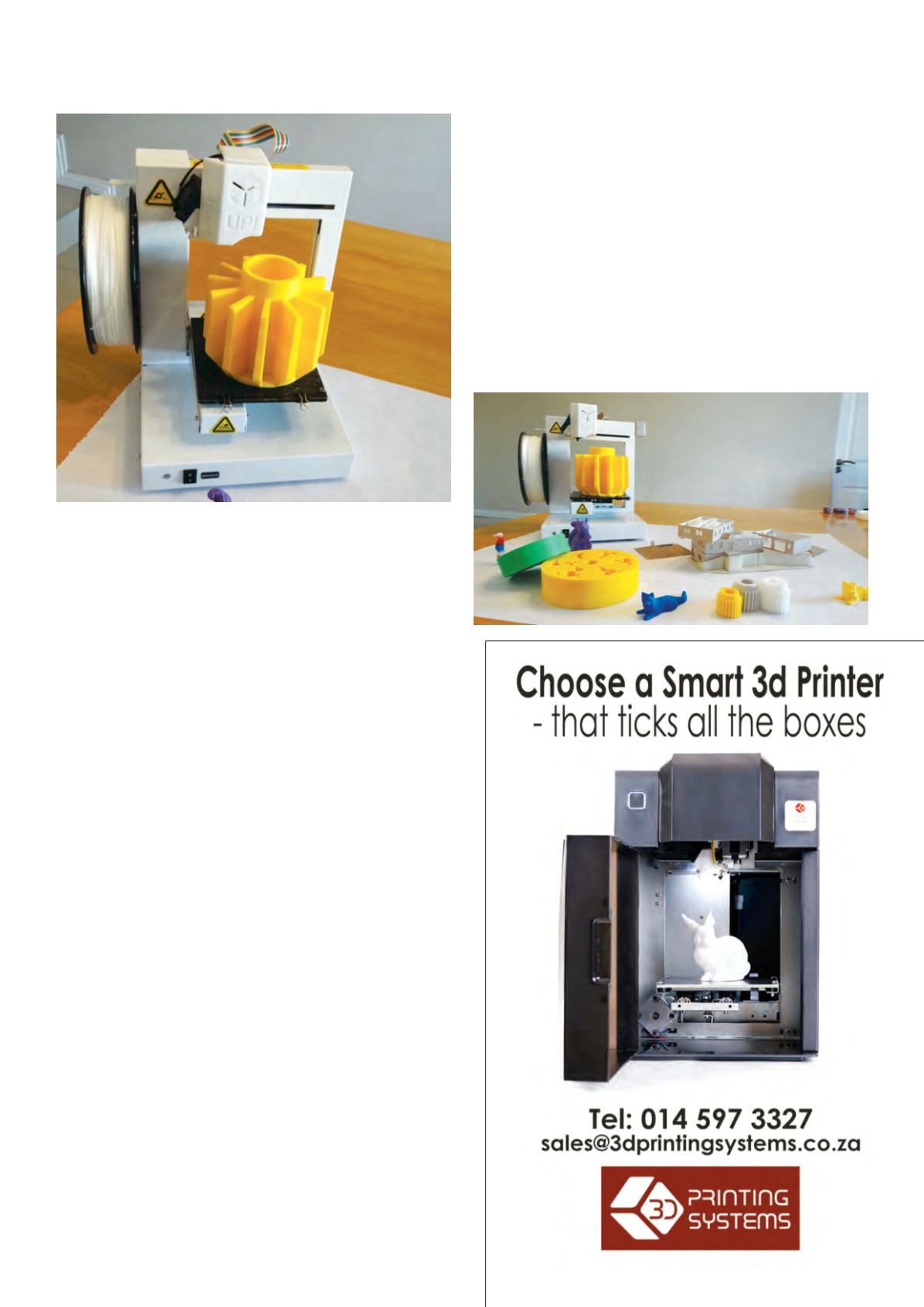
looks nothing like any printer you have ever seen. Comprising a base, a print
head, a stand for the filament and a solid case, the printer does not really look
the part. It is more reminiscent of a safe, but the printing - or magic – take place
on the inside.
However, looks, as we all know, can be deceiving. This little device can produce
any item which the user can image. Quite literally the only limitation, other than
physical size, is the imagination of the user. The printer was brought to South
Africa by Erwin von Maltitz who saw the device during a visit to New Zealand.
He quickly realised that the machine had outstanding and potentially far-reaching
implications for industry in South Africa.
As already mentioned, the printer can produce anything which the user can
imagine, providing it can be drawn on a CAD program. Once the image has been
drawn and an STL file created, the printer can make or print it. Quality of the print
is also listed as a resolution and the resolution of this device is 0.15mm. ‘Images’
are printed in a mesh form and the density of each image is determined by the
coarseness of the mesh. A very fine mesh structure will result in an almost solid
image, whereas a very coarse mesh structure will result in a hollow image.
This means that the images can created for any number of applications
or requirements.
It would be impossible to create a complete list of items which could be
printed, the same as it would impossible to list every item which is printed
two-dimensionally. However, everything from toys to engineering models,
architectural models through to prototypes which can be imaged.
Erwin commented, ‘We have experienced a high degree of interest in the
education sector where students and school pupils have seen the potential
of the printer. It allows them to give shape and form to their creative ideas. Many
of the items which are printed on this device cannot be made in any other way.
Another sector where it has attracted a lot of attention is in electronics.’
The printed items have a maximum size of 140mm x 140mm x 135mm. However,
depending on the complexity of the design and the knowledge of the designer,
items can be printed in sections and then welded together. In addition, items
can be cut into sections and the sections can be ‘grown’ on the printer.
The items which are created on the printer can be fragile or very hardy
depending on what is being created and then coarseness of the internal
mesh structure. A range of colours of the filament are available. Although the
filament was originally imported, Erwin and his small team have now managed
to find a local filament manufacturer whose filament meets all the specifications
of the printer. The final printed images or elements can be drilled, cut and
sanded depending on the application or use.
Currently more than 260 of these printers have been installed by a wide spectrum
of different companies, institutions, organisations and individuals around South
Africa. All that is required is a small initial investment, a laptop and a CAD
program. The printer connects to the laptop via USB cable and thereafter all that
is required is the ability to convert concepts into drawings which can be printed.
For more information on the 3D printer from 3D Printing Systems contact Erwin on
014 597 3327
or e-mail


