‘The problem was that at 30 to 40 years old, they were slow and they were
gradually becoming more difficult to maintain and repair. Original parts are no
longer readily available and you have to rely on specialist suppliers to have parts
made for them. With our increased productivity on the printing side it became
obvious that we needed to find an alternative.’
Given its long-standing relationship with Heidelberg Graphic Systems, this
supplier was the obvious first port of call for Multiprint Litho. Heidelberg
represents Kama in the local market and was able to offer a solution which met
not only the speed requirements but also the reliability demands of Multiprint
Litho. Baker added, ‘With our two cylinders we were able to achieve a maximum
throughput of around 3000 copies per hour. With the Kama we can achieve up to
5500 sheets per hour. Not only that but it is also a flatbed system which means
that the loading and unloading of dies is much easier and there are less chances
of problems arising with the cutting.’
Not only does the Kama offer increased productivity, but it also reduces the
amount of floor space required because the one machine take up less space
than the two cylinders. An important feature of the Kama ProCut is that it uses
a standard Heidelberg sheet feeder to move sheets from the feeder stack to the
front and sidelays. This means that it is technology which is comfortable and
familiar. Registration is assured by the front and sidelays and the floor space is
minimised by the design of the system which turns the sheet 90 degrees prior to
die-cutting. The ensures completely accurate cutting at maximum speed.
Baker commented, ‘For many years there was no alternative to the cylinder unless
you went for the large-format, high-volume die-cutting systems which were too
big for our requirements and which are more suited to packaging production. Now
with the Kama ProCut we have been able to increase productivity and quality.’
Finishing is the one area of most printing companies where productivity hits
a bottle neck. This is due to a number of factors. Either there is no in-house
expertise, or the initial outlay is too high, or it is simply easier and more
convenient to send the work out. The problem is that the volume of control is
reduced and the time frames are extended. For Multiprint Litho, perfect binding
was just such a bottleneck. PUR binding is the most effective and cost-efficient
solution but there were a number of issues which meant that bringing this
technology in-house was not a viable solution.
Baker added, ‘With the older PUR systems, there was a minimum curing time
of 24 hours before the bound products could be properly handled. This meant
lengthy production periods. There was a delay from the time the job was
delivered to the finishing house, and then the time taken to return it once
binding was complete and you could lose a large part of a week. Add to this
the fact that the job is out of your hands for that period and there are any
number of things which can go wrong.
‘There have been some major developments in PUR glue technology which has
reduced the curing time from a full day down to one hour. This means that a large
part of the delay has been eliminated. In addition, it is no longer such an involved
and precise process wrought with potential problems. Add to this the fact that
there are increased costs associated with moving printed work around due to
the e-tolls and it has become more viable to bring PUR binding in-house.’
Following a long process of investigating all the various options on the market
and comparing levels of productivity and related costs, Dave and the team at
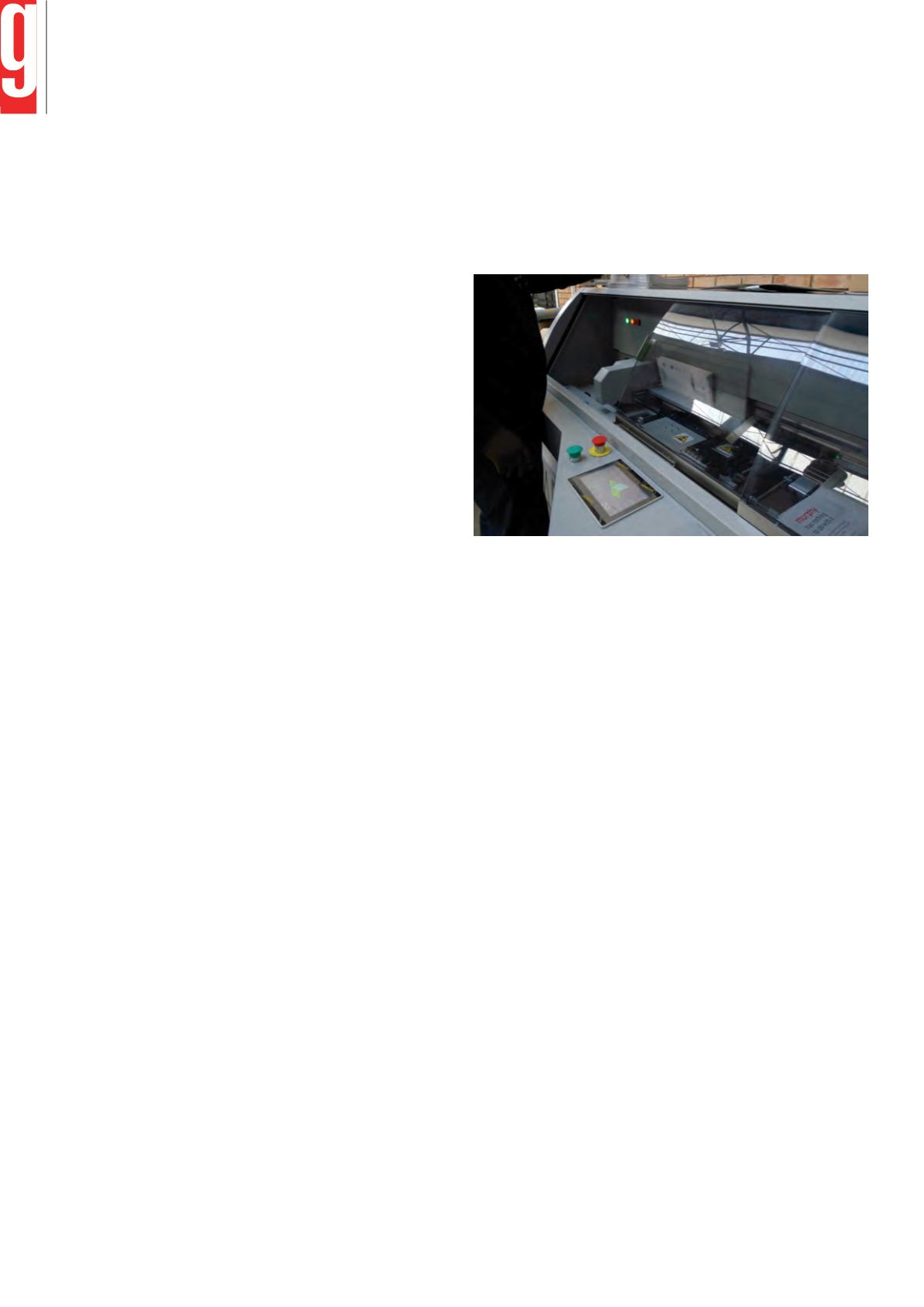
Multiprint Litho opted for the Morgana DigiBook 450 PUR binding system from
Ipex Machinery. The DigiBook 450 is a semi-automatic system featuring a cover
feeder and manual book-block loading. The system at Multiprint Litho has been
fitted with the optional scoring attachment removing the need for pre-creasing
of covers. The DigiBook can handle a range of product sizes in length, height
and thickness.
An important feature of the DigiBook 450 is that the glue is handled entirely
within the machine which means that there is no need for long feed lines and,
the problems associated with that are eliminated, there is less wastage and
there is no need for lengthy preheat periods. Glue ‘candles’ are loaded and
melted as required. Post binding there is dwell time of a few seconds allowing
the glue to cool sufficiently for the curing process to begin. Thereafter the
finished product is moved to the stack where it continues curing before it is
moved to a pallet for trimming.
Dave commented, ‘This is the first purchase we have made from Ipex Machinery
and it has been a completely smooth process. From the advice given in the
beginning through to the installation, commissioning and training the entire
process has been flawless.’
The installation of even a single piece of equipment can have a profound
influence on the productivity of a department given the learning curves
associated with understanding and operating the equipment. Multiprint Litho
has now installed three pieces of new technology in a relatively short period of
time and is already achieving optimum productivity. All of this has been achieved
without the need to employ any new staff. The HP Indigo is operated by the same
machine minder who had previously run the Heidelberg Speedmaster 52 press.
The Kama ProCut is run by the operator who had done all the die-cutting on the
cylinders and the DigiBook is also operated by an existing staff member. In all
cases the old technology has been removed and sold to make room for the
newest, state-of-the-art equipment which replaces it.
Dave added, ‘The aim is to increase productivity by working smarter, not harder.
We want to make it easy for our staff to meet their productivity goals and the
technology helps them do that. Not only that, but on a personal level they are
all receiving new skills which benefits them. The result is that they are keen and
willing to learn the new skills and to implement them and therefore, the company
and our customers benefit. We also reduce waste and reduce turnaround times
which is a major benefit in a market which is under ever-increasing pressure for
faster turnaround times.’
That is not the end of the acquisition trail for Multiprint Litho. By the time this
article went to print, a new Col-Tec suction feed collator from Ronnie Cox
Graphic Supplies had just gone into production. This was installed to speed up
the productivity of the binding department by removing some of the handwork
which could be easily automated. It features a production speed of up to 3300
production cycles per hour and can handle products from single sheets up to
64-page sections for both saddle stitching and perfect binding in sizes ranging
from 100 x 140mm up to 350 x 500mm.
Dave concluded, ‘For us technology is a tool to achieve better quality, higher
throughput volumes, more environmentally-friendly operation, better working
conditions for our staff or to simply provide our clients with better service. While
we are constantly looking for the next thing to improve our operations, we do not
jump into purchases just because something new is available. We take our time
and consider all the elements before we make a decision, so that once we do
purchase, we know it is the right thing for our business. That said, we are already
considering more acquisitions, but we are still checking and double checking
before we make any decisions.’
The Morgana DigiBook 450 perfect binder
28
I
The GAPP
magazine
www.
thegapp
.co.za
Vol 4 Issue 4 • MULTIPRINT LITHO INVESTING BOLDY IN NEW TECHNOLOGY


