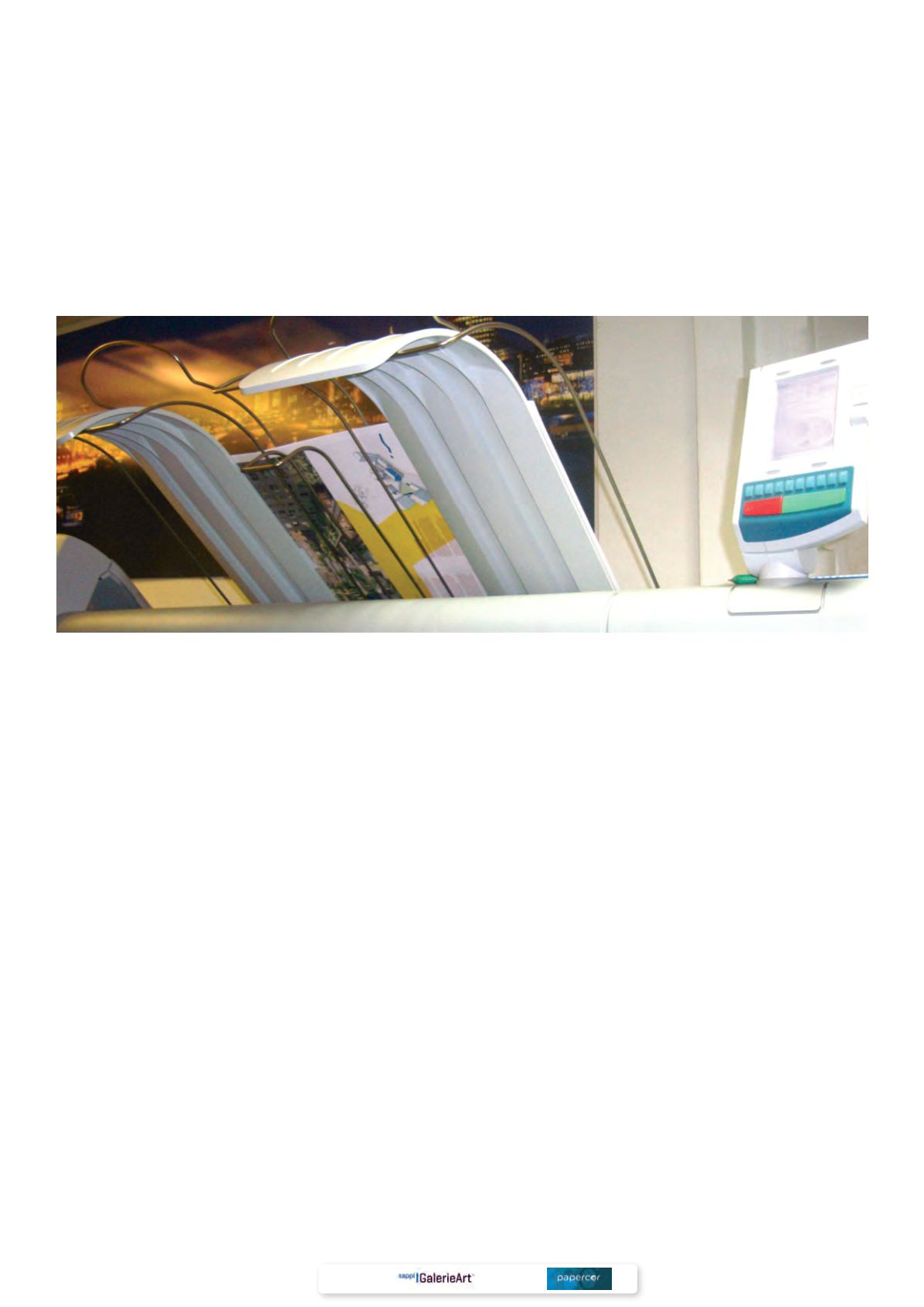
Colour and/or B&W
When choosing a wide format printer, one of the basic aspects you consider is
whether to buy a printer that can print in colour or one that prints in B&W. It may
seem a straightforward choice, but even here there are issues to consider, as
the decision has consequences for how your users will actually use the printer.
Analysing what you need based on the type of print jobs that you do, will help
determine which is the most cost effective. If you are printing posters, photos,
technical documents, drawings or presentations, you will most likely choose
colour; however, speed might force you to lean towards a B&W device, which
generally performs faster. Similarly, if your prints or copies are used outside they
need to be waterproof; prints made on B&W wide format printers will provide
this, although some colour devices offer this as an option as well.
When scrutinising the print costs of B&W versus colour, consider that, firstly, the
cost of printing a B&W print on a colour printer is approximately the same as on
a B&W printer when your monthly print volume is low; and secondly, if users start
printing potentially expensive colour prints because a colour printer is at their
disposal, managing print costs will be difficult.
Costs
When you ask about the costs of a printer, you usually get two answers; the first
will address the purchase price and the second will cover the running cost of the
system. A shrewd buyer will not base their decision on the purchase price alone,
knowing that a cheap printer with costly toner cartridges is actually an expensive
printer in disguise. These costs can be determined up front by straightforward
calculations; however, to make these calculations, you need to have access
to relevant information. Vendors tend to provide averages that may not be
representative of your actual day-to-day usage of the printer. For example,
the ink consumption calculations are usually based on a ‘fast mode’, which is
meaningless if you always use the ‘normal mode’, as most people do.
On top of the cost of consumables are those associated with the service contract;
if a service contract does not cover spare parts or software updates, you will also
have to estimate these additional costs for the short term and the long term.
Costs that are related to the printing process itself but are less obvious to identify
include for example:
• Printing on the wrong media type or media size.
• Printing files twice because it is unclear if the printer is ‘working on it’.
• Printing multiple times to get optimal print quality.
• Waiting time and frustration.
• Cost of overtime or courier service for timely delivery.
Keep this simple tip in mind: automation will help lower these hidden costs. In
the end, a system that is more automated may help prevent printing problems
before they occur.
What to consider when
buying a wide format printer
Before purchasing a wide format printer, there are a number of factors that must come under
consideration, with the choice of colour and/or black-and-white (B&W), as well as cost, performance
and speed, and image quality being the four most important areas to look at when investigating your
options. However, the savvier buyer will also look at ease-of-use, security, product options, floor space,
along with environmental concerns. There is no such thing as a one-size-fits all solution, and these
considerations will help you to make an informed choice based on what you actually need.
By Chris Paulet, product manager of the Wide Format Printing Systems
division of Océ South Africa
Printed on supplied by
I
31


