Koenig & Bauer (KBA) first-quarter report
I
n the first quarter of 2014 Koenig & Bauer (KBA)
delivered a double-digit increase in sales and or-
der intake as well as, significant improvements to
its operating and pre-tax results. At €241.5m group
order intake rose by 20.8 percent. New orders of
sheetfed offset presses were up 10.3 percent to
€146.5m, while order intake of web and special
presses increased by 41.4 percent to €95m. Nev-
ertheless, demand for web offset presses remained
subdued and along with order backlog it strained
sales and earnings. Postponed special press de-
liveries on the customers’ side led to only a slight
climb in web and special press sales from €92.5m in
2013 to €94.7m, whereas the sheetfed division gen-
erated a 20.9 percent rise in revenue to €118.7m.
A slide of nearly 20 percent in domestic sales
raised the export level from to 79.3 percent year-
over-year. Indications that demand is gradually
picking up can be seen predominantly in the south
of Europe. The proportion of the group total attrib-
utable to Asia and the Pacific jumped to 30.4 per-
cent and North America’s contribution grew to 11.4
percent. However, weak currencies in countries like
Brazil and South Africa pushed the regional total in
Latin America and Africa down to 6.5 percent.
The gross profit margin widened from twelve
months earlier to 25.4 percent. KBA posted an oper-
ating loss due to sales, but at –€10.2m this was an
improvement on the prior-year figure of –€16.9m.
Segmental results were mixed. After a longer pe-
riod of time higher sales and success in terms of
costs and prices led to an operating profit in the
company’s sheetfed offset business of €1.2m. The
web and special press division, which has largely
been profitable in recent years, posted an operating
loss of €11.4m given postponed deliveries of profit-
able security presses and insufficient capacity uti-
lisation at the group’s web press facilities. Follow-
ing a slight financial loss of €1.9m KBA improved
its pre-tax loss from €18.8m in 2013 to €12.1m. A
group net loss of €14m corresponds to earnings per
share of –€0.85.
At –€51.3m cash flows from operating activities
were negative due to lower customer prepayments,
a temporary rise in inventories and a drop in trade
payables. After deducting cash funds for investing
activities the free cash flow came to –€54.4m. At
the end of March funds stood at €131.2m and KBA
has access to ample credit lines. After deducting
bank loans totalling €22.3m net liquidity remained
solid at €108.9m.
According to KBA president and CEO Claus
Bolza-Schünemann the implementation of Fit@
All for the restructuring of the KBA group ‘made
good progress’ in the first quarter of 2014. The
programme was approved in 2013 and will be in
force until 2016. Cancellation and phased retire-
ment agreements, social wage agreements and
social compensation plans were agreed for around
700 employees at various locations as part of the
planned group-wide reduction of 1000 to 1500 jobs
by the end of 2015. Further talks with union and
workforce representatives about other capacity-
orientated staff adjustments are progressing well.
Training measures for preparing the relocation of in-
ternal production activities between the individual
plants have also begun. Given the periods of notice,
upcoming relocations and pending outsourcing op-
tions, the implementation of personnel adjustments
will not finish until the end of 2015.
Along with adapting capacities to shrunken
market segments, the realignment of KBA focuses
more strongly on growth markets, such as packag-
ing printing. In this context Bolza-Schünemann re-
fers to KBA-Kammann for the direct decoration of
glass and KBA-Flexotecnica active in the prosper-
ous flexible packaging segment. The integration of
these two subsidiaries which joined the group in
2013 ‘is well underway’.
As a result there were 6237 employees on group
payroll at the end of March 2014, compared to 6187
a year earlier. Excluding staff from the newly con-
solidated subsidiaries, apprentices, trainees, tem-
porary employees and staff on phased retirement
schemes, the group workforce sank by 166 to 5307.
The total will soon fall to below 5000 as it includes
many employees who have already left the compa-
ny or those who will leave in the course of the year.
According to Bolza-Schünemann this year, ‘will
also be characterised by the implementation of
Fit@All. This programme will realign our traditional
offset business to a significantly smaller and struc-
turally fundamentally changed press market envi-
ronment.’ Despite a rise in order intake and sales in
the first quarter, ‘we continue to target stable group
revenue of €1bn to €1.1bn for 2014.’ KBA’s relative-
ly young field of digital printing technology as well
as presses and systems for packaging printing and
special markets are expected to make larger con-
tributions to sales and will bring about a change in
product mix of the group.
The press manufacturer already made extensive
provisions against earnings for the restructuring of
the group in its financial statements for 2013. The
special expenses attached to this realignment in
2014 will be limited, but they will have an slight
impact on this year’s results. ‘As in 2013, we are
aiming once again for a positive operating result
before special items,’ said KBA’s CEO. As the profit-
boosting effects will only fully come into effect af-
ter the implementation of the Fit@All programme,
the management board expects group earnings be-
fore taxes (EBT) to be negative once again this year.
Supply chain merger a big plus for SA industry
T
he boards of directors of US-based global pro-
fessional associations for supply chain and op-
erations management, APICS and the Supply
Chain Council (SCC) have approved an agreement
under which the two will merge pending a ratifica-
tion vote by members. The organisations expect the
transaction to be complete in mid-July.
While the organisations are independently re-
garded as leaders in their field, the combination
creates the premier global organisation focused on
supply chain performance and talent development.
The strategic rationale is compelling and will lead
to greater opportunities for members, customers,
partners and employees – including the South Af-
rican organisation SAPICS, a partner of APICS for
over thirty years, and a partner of the SCC for 10.
APICS and the SCC see ample opportunities for
combined global growth, with complementary cus-
tomer bases and products enabling them and their
partners to deepen relationships with customers by
providing more high-quality products and services
– sorely needed in the skills-challenged South Afri-
can environment.
‘We are delighted to learn of the proposed
merger between the SCC and APICS. At a local level
SAPICS and the SCC have worked closely together
in the development of the supply chain community
in South Africa for many years. We look forward to
continuing this relationship,’ said Cobus Rossouw,
President of SAPICS. ‘We are particularly proud of
the involvement of Supply Chain Council in the 36th
Annual SAPICS Conference and look forward to the
excellent selection of speakers and presentations in
the programme this year which will be highlighting
the SCOR model. We wish both APICS and SCC well
in the next few weeks while plans are finalised and
look forward to continuing our work with both or-
ganisations long into the future. The SAPICS Board
will engage with the Leadership Team of the South
African Chapter of SCC in due course to agree how
best to align and integrate efforts in the region.’
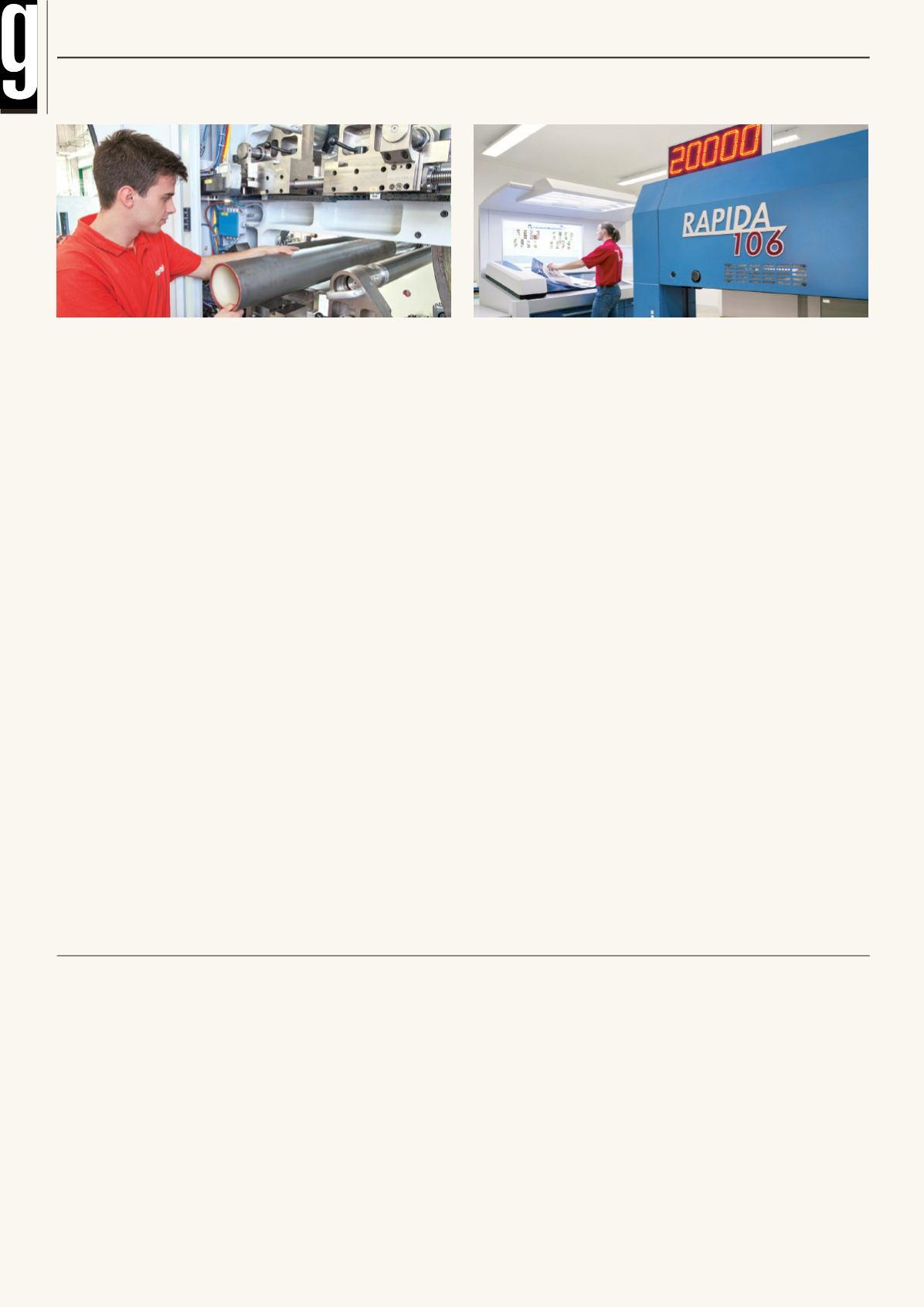
KBA-Flexotecnica in Italywhich joined the Group in 2013 serves the growing
market for flexible packaging
KBA delivered double-digit increases in sheetfed offset sales and order intake
in the first quarter of 2014 and posted an operating profit
90
I
The GAPP
magazine
www.
thegapp
.co.za
Vol 4 Issue 3 • THE GAPP TIMES


