Vol 5 Issue 1 • STREAMLINED COLOUR MANAGEMENT COLOUR COMMUNICATION
Understanding colour
To help you clearly understand how colour is measured, we should first study the
fundamentals of colour’s physical and physiological properties.
Colour results from an interaction between light, object, and the viewer. It is light
that has been modified by an object in such a manner that the viewer – such as
the human visual system – perceives the modified light as a distinct colour. All
three elements must be present for colour as we know it to exist. Let’s examine
colour’s origins in more detail by first studying light.
Light – Wavelengths and the Visible Spectrum
Light is the visible part of the electromagnetic spectrum. Light is often
described as consisting of waves. Each wave is described by its wavelength –
the length from wave crest to adjacent wave crest. Wavelengths are measured
in nanometres (nm). A nanometre is one-billionth of a metre.
The region of the electromagnetic spectrum visible to the human eye ranges
from about 400 to 700 nanometres. This amounts to a mere slice of the massive
electromagnetic spectrum. Although we can’t see them, we use many of the
invisible waves beyond the visible spectrum in other ways – from short-
wavelength x-rays to the broad wavelengths that are picked up by our radios
and televisions.
Our eyes have light sensors that are sensitive to the visible spectrum’s
wavelengths. When light waves strike these sensors, the sensors send signals
to the brain. Then, these signals are perceived by the brain as a particular colour.
Exactly which colour is perceived depends on the composition of wavelengths
in the light waves. For example, if the sensors detect all visible wavelengths at
once, the brain perceives white light. If no wavelengths are detected, there is
no light present and the brain perceives black.
Now we know how our eyes and brain respond to the presence of all visible
wavelengths or no wavelengths. Next, let’s examine how our vision system
responds to each individual wavelength.
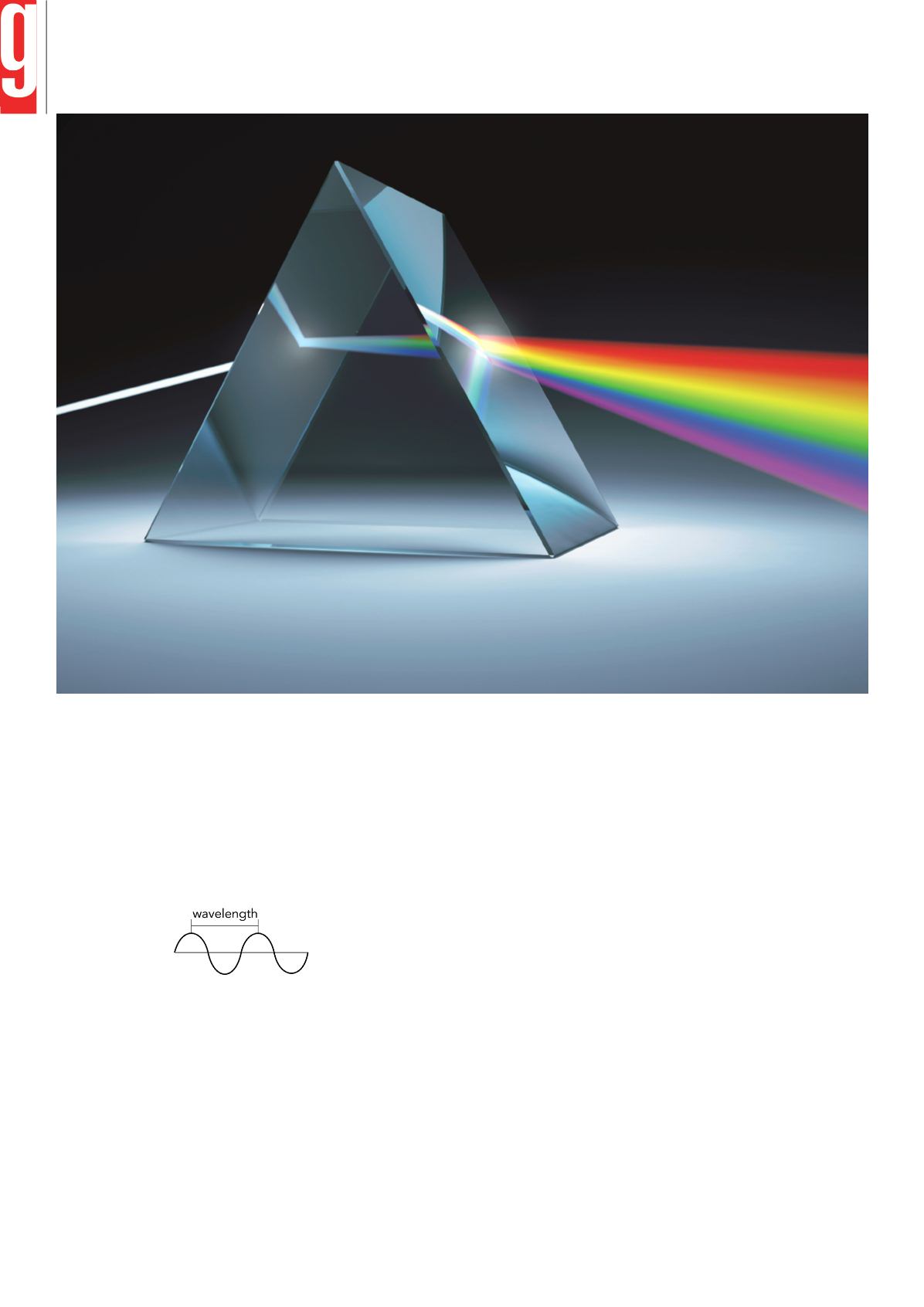
Passing a beam of white light through a prism disperses the light so that we
can see how our eyes respond to each individual wavelength. This experiment
demonstrates that different wavelengths cause us to see different colours. We
can recognize the visible spectrum’s dominant regions of red, orange, yellow,
green, blue, indigo, and violet; and the 'rainbow' of other colours blending
seamlessly in between.
When our visual system detects a wavelength around 700nm, we see 'red;'
when a wavelength around 450-500nm is detected, we see 'blues;' a 400nm
wavelength gives us 'violet;' and so on. These responses are the basis for the
billions of different colours that our vision system detects every day.
However, we rarely see all wavelengths at once (pure white light), or just one
wavelength at once. Our world of colour is more complex than that. You see,
colour is not simply a part of light – it is light. When we see colour, we are
seeing light that has been modified into a new composition of many wavelengths.
For example, when we see a red object, we are detecting light that contains
mostly 'red' wavelengths. This is how all objects get their colour – by
modifying light. We see a world full of colourful objects because each object
sends to our eyes a unique composition of wavelengths. Next, let’s examine
how objects affect light.
54
I
The GAPP
magazine
www.
thegapp
.co.za


