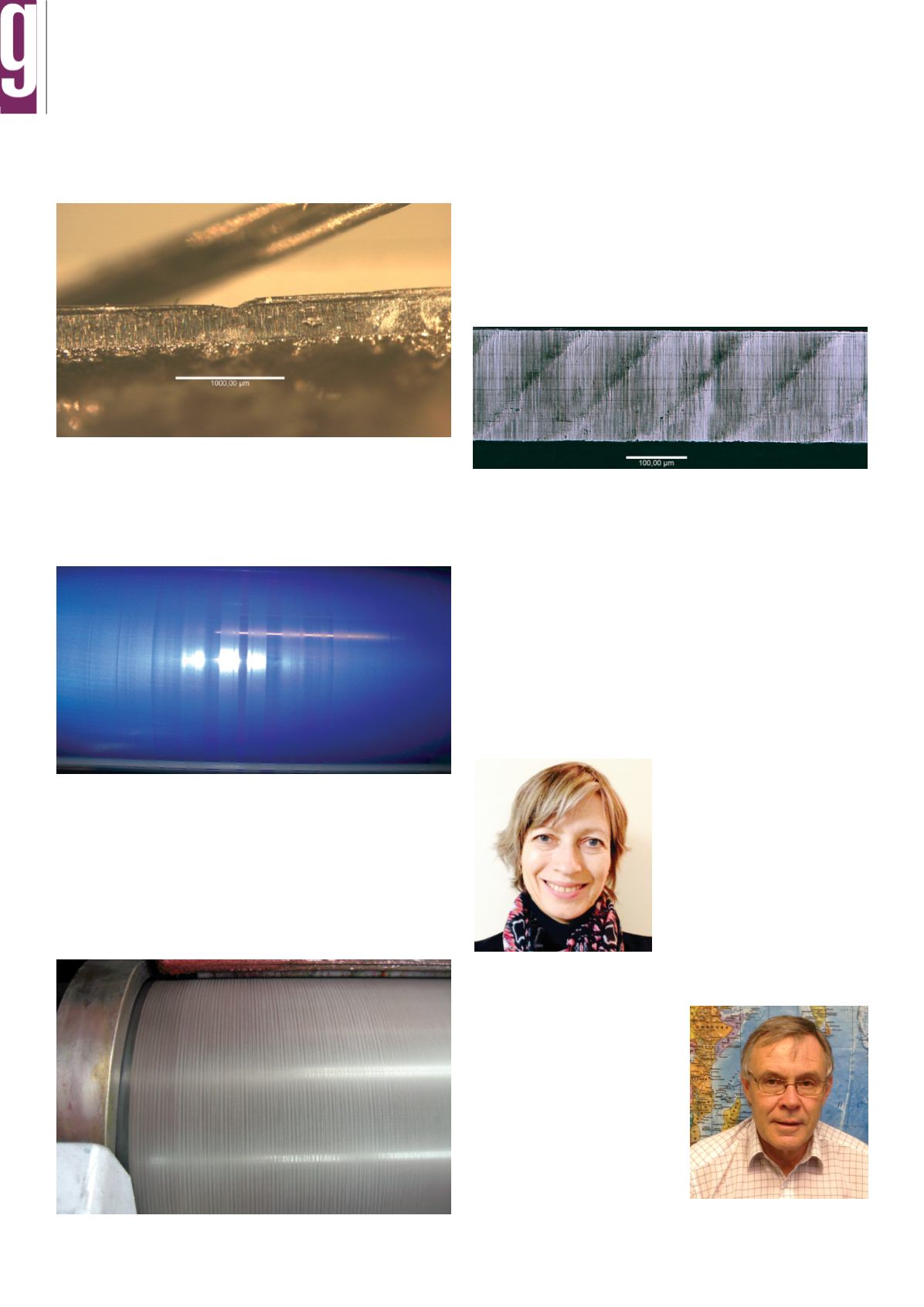
away’ by the strong adhesive in the coating unit. This blade was also used far
past the end of the lamella tip, and the width of the blade varied as much as
4,5mm along its 1700mm length. In this case, a maintenance check of the blade
holder can be recommended, as well as ensuring a higher and constant contact
angle and good parallelity between blade and cylinder.
Metallic inks
Metallic inks on labels are being used as alternatives to metallised (foil)
paperboard. Metallic inks are also used to a degree in security printing and in
printed electronics. Lamella blades with an abrasion-resistant yet lubricating.
Tree-barking
When used flexo blades have ‘normal-looking’ contact surfaces as in Figure 2,
while at the same time parallel dark line patterns appear on the used anilox
cylinder as in Figure 8, then we have clues to a case of ‘tree-barking’, in which
similar lines appear in the print. The phenomenon of ‘tree-barking’ can arise
for example, when printing with water-based inks on paper substrate. The
solution to this problem involves a use of magnets and filters in the ink system
as well as, adjustment of the ink composition to avoid the binding reaction
between components in the ink and in the paper.
New anilox engraving designs
Over the years, anilox providers have introduced different types of engraving,
generating increasing demands on doctor blades to perform clean wiping
independent of line density, cell volume and printing speed. Figures 2 and 9
reveal patterns from different types of anilox engraving. Figures 2 and 9 show
the contact surface of doctor blades which have been wiping aniloxes with
similar line-density but different engraving pattern – a conventional 60-degree
hexagonal in Figure 2 and a channel-pattern anilox in Figure 9. The varying
patterns on doctor blade contact surfaces resulting from these different
anilox engraving patterns are an extra parameter for users to optimise when
choosing blade quality and dimension. Using incorrect quality and dimension
will shorten the life of the anilox cylinder, which is very costly.
The examples given above are intended to show how continuing
developments and changes in printing processes bring along new challenges,
and that these require re-questioning and re-thinking of former solutions.
For example, a change in ink, gravure/anilox cylinder, substrate, printing
speed, job length or even machine age can bring forth new requirements on
printing process parameters including doctor blade selection and use. The
questioning of obvious past choices can be a good investment, and printers
are encouraged to do testing together with blade suppliers to fine-tune doctor
blade selection and use for the highest possible productivity at the lowest
possible total cost.
For more information contact Barkev Graphics on Tel:
087 353 9740
or visit
Figure 5: Contact surface with sliver damage from low contact angle in
hot adhesive.
Debbie Jörgensen Ågren
Håkan Olsson
R&d manager, Swedev AB,
Munkfors, Sweden
Technical support manager,
Swedev AB, Munkfors, Sweden
Debbie Jörgensen Ågren is a
metallurgical engineer with a B.A.Sc.
degree from the University of British
Columbia and 20 years of experience
within the steel industry, including
leading projects in the process
development and marketing of
speciality steels. She joined
Swedev in 2006 as research &
development manager.
Håkan Olsson joined Swedev in 2008
as technical support manager. He
has over 35 years of experience in
the printing industry, including
the responsibilities of plant
commissioning and technical training
at a leading global liquid packaging
company. He has lived and worked
on three continents and consulted
in countries all over the world.
Figure 7: Anilox cylinder with inconsistent distribution of UV-ink.
Figure 8: Tree-barking pattern on anilox cylinder.
Figure 9: Doctor blade contact surface with pattern from a
channel-engraved anilox cylinder.
30
I
The GAPP
magazine
www.
thegapp
.co.za
Vol 4 Issue 3 • FINE-TUNING OF DOCTOR BLADE USE IN CHANGING PRINTING PROCESSES


