2
015 will see the global economy grow at its fastest-rate in three years. The
acceleration is built on stronger growth in the USA. The low oil price looks
likely to be a feature of the year as does the weak recovery in the eurozone
which risks fizzling out all together with the spectre of deflation hanging
over the region. Overall, the outlook for the global economy continues
to be uncertain as risks remain pronounced.
From peak to weak oil
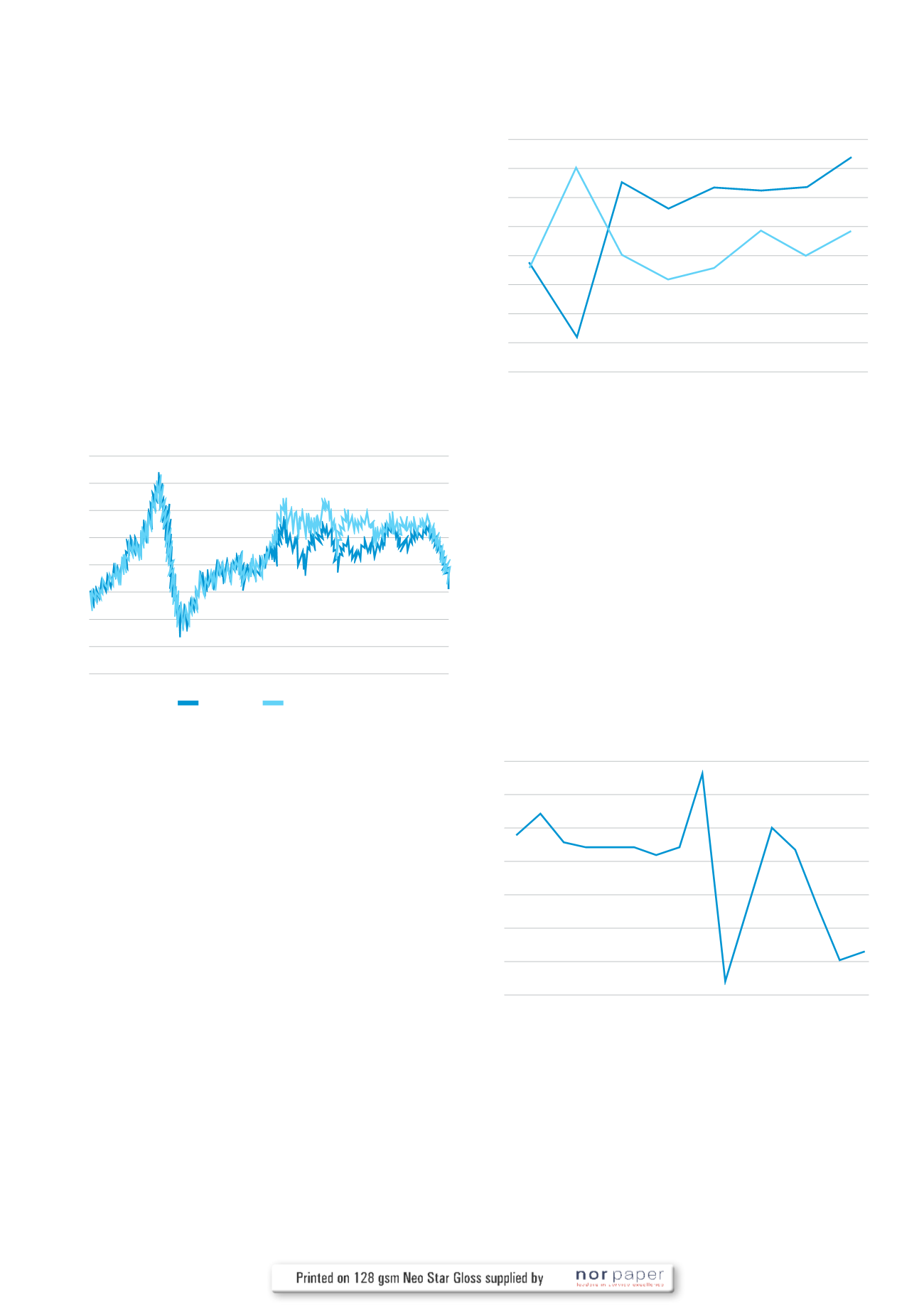
In December 2014 the oil price fell to below US$65 per barrel and in 2015 we are
forecasting US$82.0 (Europe Brent Spot Price) for the year as a whole. The low
price is down to an excess of supply over demand as the US and Canada have
become large producers and supplies (unusually) have not been affected by the
turmoil in the Middle East. This has come at a time of subdued demand due
to the economic slowdown in the eurozone and the manufacturing slowdown
in China.
Daily Crude Oil Price: January 2007 – December 2014
Source: Energy Information Administration
There will of course be winners, losers and those that break even from the low
price. Winners are the large oil importing countries such as India and Japan.
Losers will be the major oil producers, including the Gulf States but more notably
those suffering from other economic problems such as Russia and Venezuela.
Russia is over-reliant on energy resources and a low oil price will add to its
economic woes and is already weakening the rouble. Countries that import oil at
the same time as producing their own may find the low price offsets itself. China
is one example. In addition Canada and the US may find that extracting their
supplies becomes less and less cost-effective.
US resurgent
We are forecasting a strong year for the US economy, with real GDP growth
currently estimated to come in at 3.3 percent. This will be the strongest rate of
growth for 10 years and with it the USA will be a significant contributor to global
economic growth. Its relatively small export sector (exports accounted for 9.4
percent of GDP in 2013) enable it to withstand global economic conditions to
some extent. In particular, according to the OECD, it is more insulated from a
eurozone slowdown than other major economies such as Japan and the UK.
The situation is not all rosy though – in particular wages are stagnating despite
an increasingly strengthening labour market. In 2014 we estimate that the
average wage per hour remained unchanged in real terms over 2013 and we
forecast a rise of just 0.9 percent in 2015. This contributes some fragility to the
recovery, as wage growth is needed to drive consumer expenditure. It also adds
complexity to the Fed’s debate on when to raise interest rates.
Real GDP Growth and Growth in Wage per Hour in the USA: 2008-2015
Source: Euromonitor International from national statistics/OECD/UN/IMF/BLS
Note: Data from 2014 onwards are forecast
Eurozone in the doldrums (again)
The second half of 2014 and 2015 brings a sense of déjà vu with regards to the
economic situation facing the eurozone. In 2015 we are forecasting real GDP
growth of 1.1 percent. The region is suffering from subdued productivity growth,
high unemployment and is weighed down by debt. We are not currently expecting
the eurozone economy to shrink but we are expecting growth to be anaemic
at best.
This time the situation is compounded by lowflation and the threat of deflation
which haunts the currency bloc. In November 2014 inflation fell back to a five
year low of 0.3 percent. In 2015 we are forecasting inflation of 0.6 percent in the
eurozone, with major economies such as Spain and Italy coming in at 0.0 percent.
Deflation is a concern as it increases the debt burden, suppresses investment
and consumer spending, with business unsure of ROI and consumers holding off
for lower prices. This can quickly spiral into a vicious circle and fears are that the
eurozone could face a Japanese-style lost decade.
Inflation in the Eurozone: 2000-2015
Source: Euromonitor International from Eurostat/national statistics
Note: Data from 2014 onwards are forecast
Up in the air
These are three trends amongst many to watch in 2015 including further
geopolitical tensions, the birth of new economic groups – ASEAN’s AEC and the
Eurasian Economic Union, sluggish trade growth and the strong US dollar. 2015
should see another incremental step towards a stronger global economy, but the
recovery remains fragile and risks are such that there remains a danger that it
could be derailed.
- See more at:
-
finance-2015.html#more
2007
0
20
40
60
80
100
120
2008
2009
2010
WTI Cushing
US$ per barrel
Europe Brent
2011
2012
2013
2014
-4.0
-3.0
-2.0
-1.0
0.0
1.0
2.0
3.0
4.0
Annual % growth
2008
2009
2010
2011
2012
2013
2014
2015
2000
2002
2004
2006
2008
2010
2012
2014
0.0
0.5
1.0
1.5
2.0
2.5
3.0
3.5
Annual % growth
I
33


